On June 25, 2021, Dr. Wang Yubo, member of the China-Germany Expert Group on Intelligent Manufacturing of Germany’s Industry 4.0 Strategy Implementation Guide, founder of YWA platform of Germany and Chief Assistant of German Academy of Science and Arts, delivered a lecture on the trend of intelligent manufacturing industry development for teachers and students of USTB online.
Industry 4.0 is an era of boosting industrial revolution by using information technology, which is also known as the era of intelligence. The concept was first presented in Germany, and was officially launched at the Hannover Messe 2013 with core purpose of improving the competitiveness of German industry in the new round of industrial revolution. Latter this concept was included by German government into one of the ten future projects in Germany’s 2020 High Technology Strategy.
The programme aims to improve the intelligence level of German manufacturing, and build smart factories with adaptability, resource efficiency and genetic engineering and it will integrate customers and business partners in business processes and value processes. The programme is based technically on cyber entity system and the Internet of Things, which digitizes and intelligentizes the supply, manufacturing and sales information in production, and finally achieves fast, effective and personalized product supply.
The cooperation between China Intelligent Manufacturing and Germany Industry 4.0 owns a long history. In the Memorandum of China-Germany Cooperation Outline signed by both sides, there are 4 articles on Industry 4.0 cooperation. The first one clearly points out that the digitization of industrial production is Industry 4.0, which is of great significance for the future development of the economy in China and Germany. Governments of both countries believe that they should provide policy support for enterprises to participate in this process.
During the lecture, Dr. Wang introduced the core idea of Germany Industry 4.0 in detail, including value chain improvement, full product life cycle, CPS, private customization and flexibility of production space.
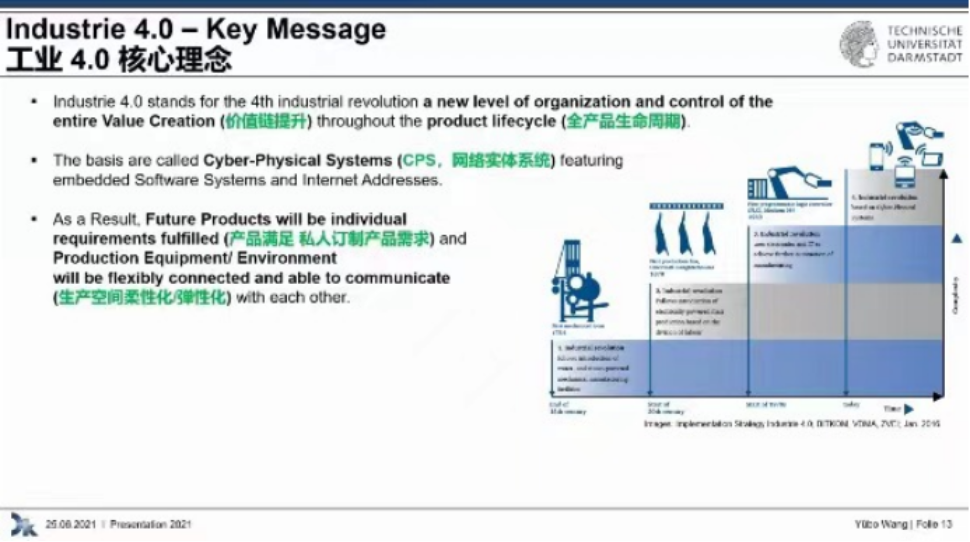
How to make enterprise in the era of Industry 4.0 more valuable? He pointed out that we should focus on the innovation of products, services and new business models. For example, we can reduce costs by making automation more available and achieve mass production of products. And we can use ERP to optimize enterprise information system, develop various types of small-batch intelligent products and utilize new business model to achieve private customization.
Dr. Wang showed the value chain development diagram of the whole product life cycle, and the main target of Industry 4.0 is to improve the value chain of the product life cycle.
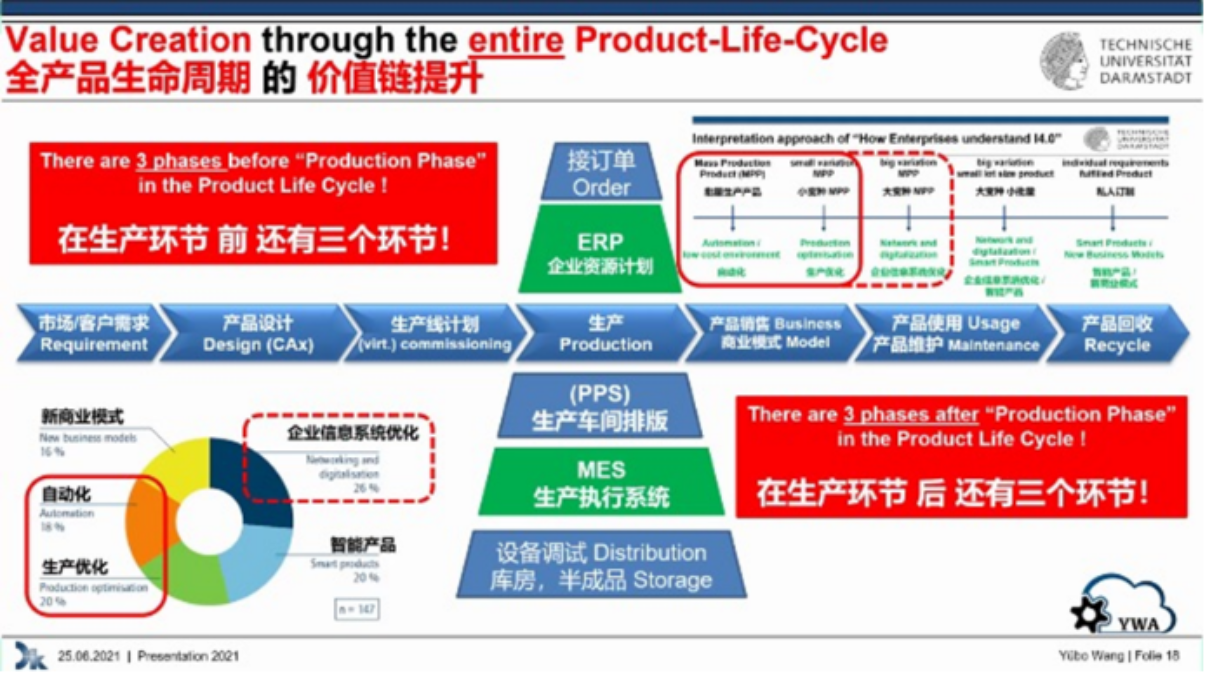
Different stages of informatization of enterprises revolve around the production link. Before Production Phase, there are three phases: Requirement, Design, and Commissioning. After production, there are mainly Business, Usage, Maintenance, and Recycle. The manager needs to have an overall perspective to analyze the current stage of an enterprise. If the enterprise is facing a transformation, it should implement informatization construction needed in the transformation period.
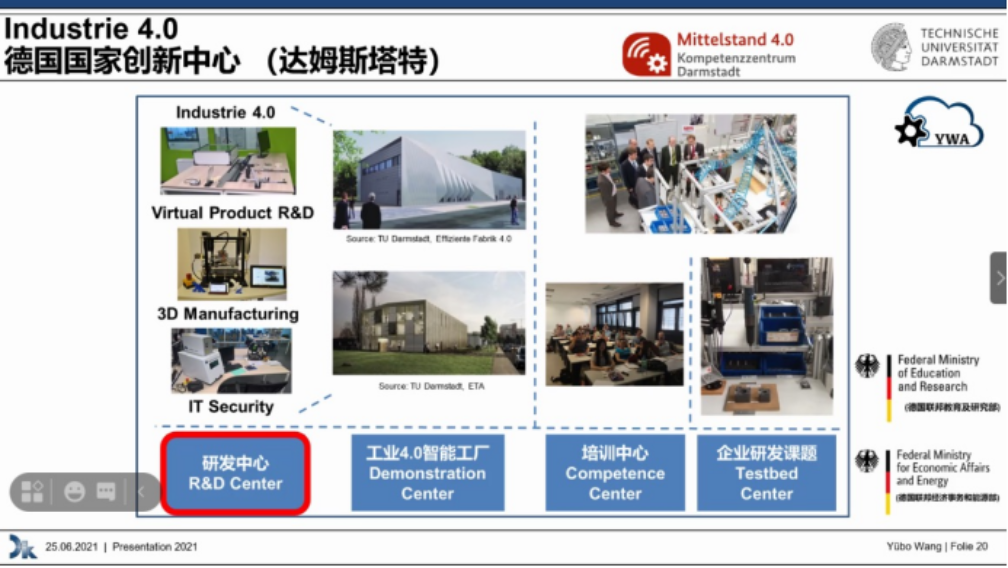
Smart factory is one of the important bases of Germany’s Industry 4.0 strategy, and all objects in the factory are connected to each other. Taking the digital twin factory as an example, it mainly reflects the two-way information flow among actual and virtual environment and the subsystems.
During the discussion, students asked Dr. Wang, “Can the remote optometry technology of ophthalmic equipment use the Internet of Everything technology? And how can Chinese enterprises realize intelligent manufacturing?” Dr. Wang answered, “Carl Zeiss AG is an example in the application of Internet of Everything technology, which fully applies automation to production. Chinese manufacturing enterprises must improve product innovation and management capabilities through digital transformation to boost quality and efficiency. In this way, China will be more competitive and can realize the transformation from manufacturing to intelligent manufacturing.”
China is in an important time window for manufacturing upgrading with unique opportunities in industrial development. The story of the transformation from “Made in China” to “Intelligent manufacturing in China” is being staged. With the advent of the 5G application, many Chinese tech companies have risen rapidly, thus further boosting “intelligent manufacturing in China”. During the COVID-19 pandemic in 2020, many intelligent manufacturing enterprises showed their “intelligent manufacturing” strength. In the face of restricted travel of residents, impeded resumption of work by enterprises and medical staff shortage, some intelligent manufacturing enterprises have launched food delivery drones, automatic temperature measuring robots and intelligent medical service robots, relying on technology accumulation and manufacturing advantages to help during the pandemic.
In 2021, intelligent manufacturing has become the main direction of China’s construction of a strong manufacturing country. Accelerating the development of intelligent manufacturing is the only way towards high-quality development of manufacturing and gain new advantages in international competition. The development of artificial intelligence, industrial Internet, big data, cloud computing and other technologies provides great opportunities for the transformation and upgrading of the manufacturing industry. Intelligent manufacturing demonstration projects have delivered good results, and the large-scale promotion is just around the corner.