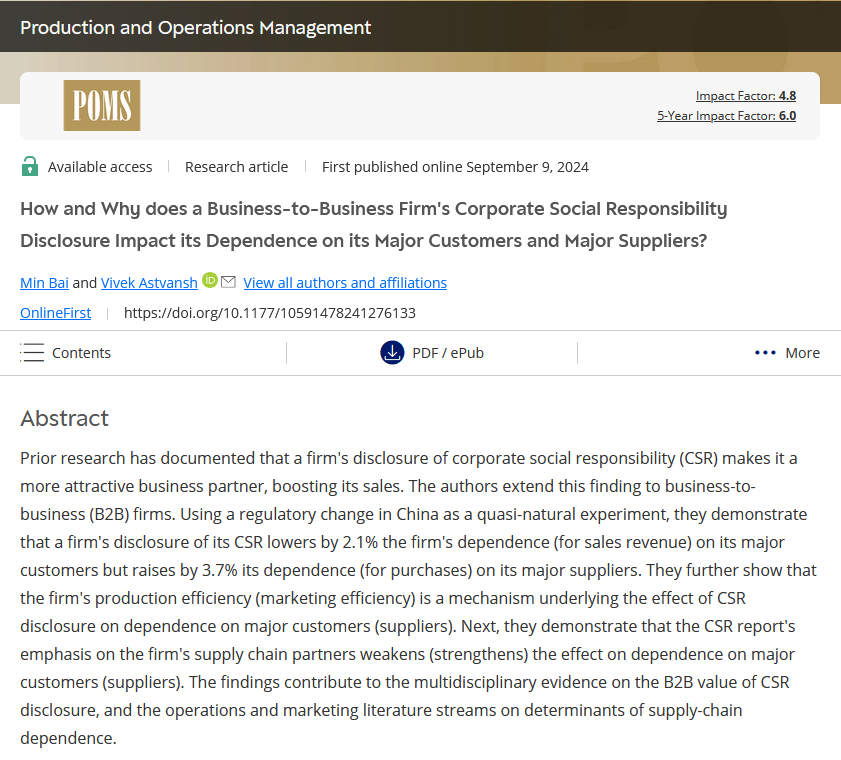
In recent years, with growing attention from all sectors of society to corporate social responsibility (CSR), an increasing number of listed companies have actively disclosed CSR reports, which has sparked extensive discussion in academia regarding their economic consequences. Although prior studies have shown that CSR disclosure has important effects on financial performance and investment behavior, its role in operations management remains much less understood. Against the backdrop of increasingly complex global supply chains, it is particularly important to examine the relationship between CSR disclosure and supply chain management.
Motivated by this issue, the paper exploits the 2008 exogenous shock created by the mandatory CSR disclosure requirement imposed on certain listed firms by China’s Shanghai and Shenzhen Stock Exchanges to investigate how CSR disclosure affects firms’ supply chain dependence. The study finds that CSR disclosure has asymmetric effects on dependence on major suppliers and major customers: specifically, CSR disclosure reduces firms’ dependence on major customers, while increasing their dependence on major suppliers. Further analysis shows that CSR disclosure improves firms’ production efficiency and marketing efficiency, which in turn leads to opposite changes in dependence relationships in sales and procurement. In addition, the study finds that the degree to which firms value the supply chain can either strengthen or weaken the impact of CSR disclosure on supply chain dependence. These findings provide a new perspective on how firms can optimize supply chain management through CSR disclosure and carry important practical implications.
The paper makes three main contributions. First, it extends the literature on the determinants of supply chain dependence. Although some scholars have widely examined the economic consequences of supply chain dependence, relatively little research has focused on its antecedents. By leveraging the setting created by China’s mandatory CSR disclosure policy, this study reveals how CSR disclosure affects firms’ dependence on supply chain partners through improvements in firm efficiency. Second, it deepens the understanding of the economic consequences of CSR disclosure. Existing CSR research has largely focused on outcomes related to stakeholders such as shareholders and employees, whereas this paper shifts attention to supply chain partners for the first time, thereby broadening the scope of research on the consequences of CSR disclosure. Third, it provides stronger guidance for business practice. The study offers firms new insights into both the benefits and potential drawbacks of CSR disclosure in the supply chain context. It also provides market regulators with a stronger theoretical basis for improving CSR disclosure policies.
Production and Operations Management is an academic journal in the field of operations management in manufacturing and services, primarily publishing scientific research on product and process design, operations, and supply chains. It is one of the 24 top academic journals in business schools selected by the University of Texas at Dallas (commonly referred to as the UTD24) and also one of the 50 top academic journals in business schools recognized by the Financial Times (commonly referred to as the FT50). The journal enjoys a high academic reputation in the international management community.
Contributed by: Office of Scientific Research and Discipline Development
Editor: Lu Qi
Reviewed by: Huang Xiaoxia